

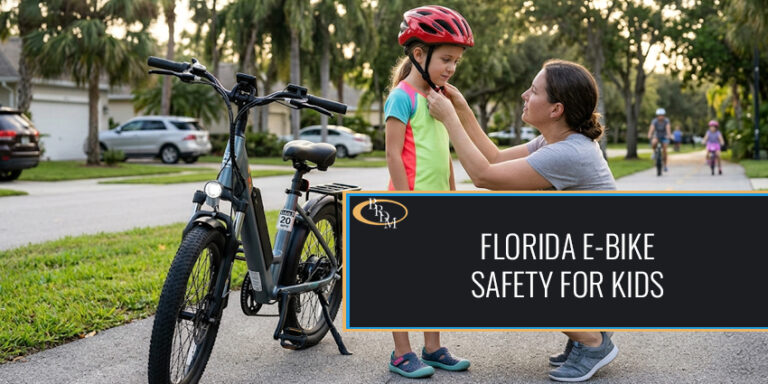
E-bikes have moved from niche to normal in Florida. As a result, more kids now ride faster, heavier bikes on the same sidewalks, trails, and neighborhood streets they once used on pedal-only bicycles. Consequently, Florida e-bike safety for kids has become a daily concern for parents, schools, and communities.
Several factors drive that shift. First, e-bikes make longer rides feel easy, so kids go farther from home. Second, the bikes accelerate quickly, which changes reaction time at intersections and driveways. Third, many models look like bicycles, so families sometimes underestimate the speed and stopping distance.
Local attention has also increased. For example, community reporting and public conversations, including mentions tied to the Tampa Bay Times, have helped parents notice how often crashes happen and how serious injuries can be.
Table of Contents
What Counts as an E-Bike in Florida and Why It Matters for Kids
Florida law treats certain e-bikes as bicycles, but only if they meet specific criteria. An electric bicycle uses a motor to assist the rider, yet it still has working pedals. By contrast, many electric scooters have a standing deck, while mopeds and electric motorcycles usually operate more like motor vehicles and often trigger different rules.
Florida Statutes Chapter 316 sets the framework. Importantly, the law uses a class system to define how the motor works and how fast it can assist. Because kids ride what parents buy, these classes matter. Speed affects injury severity, and higher speeds increase the risk of traumatic brain injuries. Accordingly, Florida e-bike safety for kids starts with picking the right type of bike.
Furthermore, if someone modifies an e-bike to exceed legal limits, the device may lose its bicycle status. Then it can fall into moped or motorcycle territory, which can change where it can ride and what rules apply. As a result, Florida e-bike safety for kids includes checking the label, the top assisted speed, and whether the bike has been altered.Florida recognizes three main e-bike classes.
- Class 1: Pedal assist only. Motor helps while pedaling and stops assisting at 20 mph. Closest to a traditional bicycle.
- Class 2: Throttle capable. The bike can move without pedaling, but assistance stops at 20 mph. Sudden acceleration means younger riders may need more supervision.
- Class 3: Pedal assist up to 28 mph. Higher speeds increase crash risk, and Florida law requires riders to be at least 16 years old to operate a Class 3 e-bike.
Safety Gear and Helmet Rules for Kids
Parents do not need a long checklist. Focus on gear that prevents serious injury and improves visibility.
Start with the basics:
- Properly fitted helmet that meets CPSC standards. Florida law requires kids under 16 to wear a helmet when riding a bicycle. Therefore, this helmet rule applies to e-bikes too.
- Front and rear lights. Lights improve visibility even during the day, especially on shaded streets.
- Bell or horn. Helps alert pedestrians and other riders on shared paths.
- Closed-toe shoes. Provide better grip and foot protection.
- Reflective gear or bright colors. Clothing, backpacks, or bike reflectors help drivers notice riders sooner.
While no gear can prevent every injury, helmets, good visibility, and basic protective equipment can greatly reduce the risk for kids riding e-bikes. Parents should keep the rule simple: no helmet, no ride.
Supervision and Age Readiness for Florida E-Bike Safety for Kids
Parents often ask about a minimum age for e-bike riders in Florida. State law does not always give a clear answer for everyday safety decisions, so parents should treat age as a readiness decision, not just a birthday milestone.
Common risk factors include:
- Misjudging traffic speed at intersections
- Entering driveways or crosswalks without scanning for vehicles
- Sidewalk riding that creates blind conflicts at corners and curb cuts
Due to these risks, Florida e-bike safety for kids depends heavily on supervision and skills practice. A practical approach includes:
- Match the e-bike class to your child’s maturity and neighborhood traffic
- Set clear boundaries for where your child can ride
- Ride together at first to practice scanning, signaling, and braking
- Use speed settings or parental controls if your e-bike allows them
These simple steps strengthen Florida e-bike safety for kids without relying on guesswork.
Where You Can Ride in Florida: Sidewalks, Streets, Trails, and Parks
Florida generally gives e-bike riders the same rights and duties as bicyclists when the bike qualifies under the class system. However, cities, counties, and property managers may set additional rules for trails, parks, or pedestrian areas. Always check local signs before your child rides.
Different riding environments create different risks:
- Sidewalks: Less exposure to traffic but more conflicts at driveways, intersections, and blind corners
- Streets: More predictable traffic patterns but require strong rule-following and awareness
- Multi-use trails: Often safest for families, but crowded paths require slower speeds and yielding to others
A bell and clear passing etiquette can also improve Florida e-bike safety for kids on shared paths.
Rules of the Road Kids Must Learn Before Riding Near Cars
If your child rides near vehicles, teach rules the same way you teach swimming: step-by-step, then repeat until it sticks.
Start with these essentials:
- Stop at stop signs and red lights. Rolling through creates sudden conflicts.
- Scan left, right, then left again. Make it a ritual at every crossing.
- Signal turns early. Drivers need time to react, especially in neighborhoods with parked cars.
- Yield when required. Right of way mistakes cause many intersection crashes.
- Avoid sudden turns and swerves. Predictability keeps riders alive.
- Stay alert. Do not ride with headphones, since they reduce awareness of cars and sirens.
Since vehicles weigh thousands of pounds, kids should ride in ways drivers can easily predict. Therefore, Florida e-bike safety for kids depends more on visibility, signaling, and following traffic patterns than on riding fast.
Common Hazards That Lead to Child E-Bike Injuries
Many child e-bike crashes follow the same patterns. Once parents recognize them, they can plan routes and rules to reduce risk. In addition, these hazards often show up in emergency room visits, including head injuries, so prevention matters.
Common scenarios include:
- Driveway pullouts where a driver does not see a child on the sidewalk
- Parked cars and dooring when a door opens into the rider’s path
- Fast downhill sections that increase stopping distance
- Wet pavement that reduces traction during braking and turning
- Sand and loose gravel, especially near beach areas and roadside shoulders
- Uneven sidewalks and cracks, which can eject a small rider
- Storm grates and puddles, which hide defects and pull tires
Rather than fearmongering, treat these as predictable problems with practical fixes. For example, choose routes with fewer driveways. Likewise, slow down near parked cars and intersections. Also practice emergency braking in a safe area. Each step supports Florida e-bike safety for kids in real-world Florida conditions.
After a Child E-Bike Crash: What to Do
After a Florida e-bike crash, act in a clear order. First comes health. Then comes documentation.
1) Put medical care firstCall 911 for emergencies. Seek medical evaluation for head impacts, even if your child seems fine. Also watch for concussion signs. Since concussions can cause long-term harm, take symptoms seriously.
2) Document the sceneIf it is safe, take photos of the roadway, signage, lighting, and any debris. Photograph the bike, including brakes, tires, and any class label. Collect vehicle information if a car was involved. Get witness names and phone numbers. Additionally, note time, location, and weather conditions.
3) Report appropriately and keep recordsContact law enforcement when needed. Notify the relevant property owner or agency if a road defect, poor lighting, or unsafe surface contributed. Keep all records of ER visits, follow-up care, prescriptions, and time missed from school. Because details fade, write down your child’s symptoms and pain levels each day.
These steps protect your child’s health. They also preserve information that can matter later. Therefore, Florida e-bike safety for kids includes knowing what to do after the worst happens. An experienced Florida personal injury lawyer can also help review the situation, preserve evidence, and protect your family’s rights if negligence played a role.
FAQs (Frequently Asked Questions)
What defines an e-bike under Florida law, and why does it matter for children’s safety?
In Florida, an electric bicycle is a bike with working pedals and a motor that assists the rider. The law divides e-bikes into three classes based on motor function and speed, which affects how fast they can go and the risks for young riders. Modifying an e-bike beyond legal limits can change its classification and the rules that apply.
What are the different e-bike classes in Florida and their implications for kids?
Florida recognizes three e-bike classes: Class 1 pedal assist up to 20 mph, Class 2 throttle capable up to 20 mph, and Class 3 pedal assist up to 28 mph. For kids, Class 1 is usually the safest, Class 2 may require extra supervision, and Class 3 is better suited for mature teens due to higher speeds.
What helmet requirements exist in Florida for children riding e-bikes?
Florida law requires riders under 16 to wear a helmet when riding a bicycle or qualifying e-bike. Parents should choose a properly fitted CPSC-approved helmet, replace it after major impacts, and enforce a simple rule: no helmet, no ride.
How should parents approach supervision and age readiness for kids riding e-bikes in Florida?
Since Florida law does not set a minimum age for most e-bike riders, parents should focus on maturity and skill, not age alone. Supervise early rides, match the e-bike class to your child’s ability, set clear riding boundaries, and consider speed limits or parental controls.
Was Your Child Injured in an E-Bike Accident? Get Legal Help Today
Some e-bike crashes happen by chance, but others occur because someone was careless, such as a distracted driver, unsafe property conditions, or defective equipment. When a child is injured, families may face medical bills, rehabilitation, and other long-term challenges. However, if negligence played a role, your family may be entitled to compensation for medical care and other losses.
At Battaglia, Ross, Dicus & McQuaid, P.A., we help families understand their rights after a serious e-bike accident in Florida. Our team can investigate what happened, preserve evidence, handle insurance communications, and pursue compensation for medical care and other losses when negligence is involved.
If your child was injured in an e-bike crash and you believe someone else’s carelessness played a role, contact us today for a free consultation. Your focus should be on your child’s recovery. Let us help protect your family’s rights.